The 2021 season of the European Ethics Bowl was organized after a successful pilot in 2020. Seven new member institutions joined the competition. Five organized an institutional competition and sent their winning team to the semifinal round.
In the initial months of the pandemic, countries were closing down one after another and city streets were emptier than ever. As everything shut down to combat the pandemic, the impact of human activity on the environment became even more apparent. With this in mind as well as taking into account the increasing number of natural disasters, extreme weather events, and climate change, the decision to choose Environmental challenges as the main theme for EEB 2021 was simple.
Institutional competitions
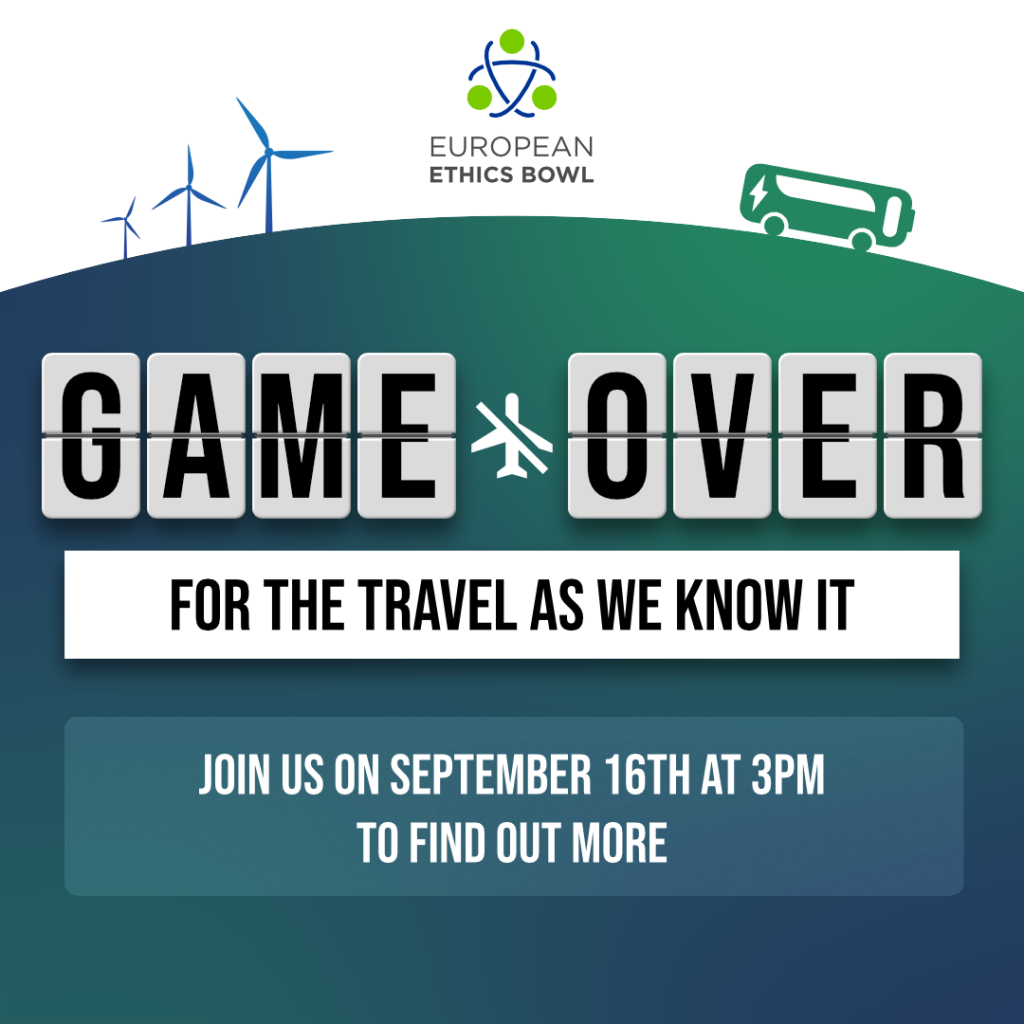
nstitutional competition was organized by the institutional members. The case study was presented during the launch of EEB 2021 and revolved around the taxation of high-pollution means of transport.
The dilemma faced by the participating teams was: “Should the EU tax high-pollution means of transportation such as short-distance flights within the EU, even though this might restrict the younger generation from experiencing what European integration means?”
Participating teams had one week to present their thoughts and opinions on this dilemma in a 3-5 minute video. During the competition, they discussed their views with the opposing team and answered any questions posed by the jury.
In the semifinals, nine teams from across Europe competed for three spots in the finals. The case study, which was presented to them almost two weeks before the actual competition, dealt with the ethics of pricing. The teams then had one week to create a 3-5 minute video explaining their views on the given dilemma.
The dilemma was: Promote environmental consciousness and still need to pay for measures against climate change. Who shall pay the bill? Shall poor people live in worse environmental conditions?
At the beginning of the debate, they were given videos of the two opposing teams and had 30 minutes to prepare the questions. After the time was up, they debated with the opposing teams and answered the questions posed by the judges.
After an hour of high quality debates, it was difficult for the judges to decide which teams had won each debate. In the end, teams from Prague University of Economics and Business (Czech Republic), Université Paris Dauphine (France) and Goethe University Frankfurt (Germany) qualified for the final round of competition.
In the final round of EEB 2021, three teams dealt with the topic of just transition. They received the case study the morning of the competition and had about eight hours to study the topic and prepare for the competition. The teams were presented with the dilemma: “Should the” just transition” be a market-based or policy-induced transition, and who should have a voice in this policy-making process. Those who are most affected or those who pay for it?”
In the final round, all three teams first presented their views directly to the opposing teams, judges and esteemed guests. Then they had a few minutes to prepare questions for the opposing teams. After that, they debated on the presented topic and answered the questions of the opposing team and the judges.
After a long deliberation the judges announced the winning team – team Germany from the Goethe University Frankfurt.
The European Ethics Bowl was a great experience. It not only encouraged us to deal critically with topics regarding climate change and the concerns, which arise within. It also gave us an opportunity to exchange with international students our age who must tackle the same problems. By embedding and sharing one ´s self-gained experience into the argumentation, it helped us to enrichen our perspectives and thoughts on the matter at hand.
Anna-Katharina Schröter, Clara Lieber & Carmen Mercedes Preiss
Winning team of EEB 2021, Goethe University Frankfurt, Germany